Preparing Parker County Land For Sale To Builders
Wondering why some Parker County land listings get serious builder attention while others stall? In many cases, the difference is not just acreage or location. It is how clearly the property is documented before it hits the market. If you want to sell land to a builder or small developer, this guide will help you understand what to prepare, what can affect your pricing, and how to reduce avoidable surprises. Let’s dive in.
Builders usually move fastest when the tract has fewer unknowns. In Parker County, that often means the property has a clear paper trail, known access, a documented path for utilities, floodplain and drainage information, and current tax status already checked.
That matters because platting and recording requirements in Parker County ask for precise survey references, deed history, utility easements, drainage or floodplain details, and tax-related documentation before a plat can be recorded. If your tract is easier to evaluate upfront, it can be easier for a buyer to underwrite risk and make a stronger offer.
Before you market land to builders, gather the documents that help tell the full story of the tract. Parker County records deeds, liens, and plats through the county clerk, and the county notes that the online database is not the official repository.
That means a final record check should be made with the clerk rather than relying only on online records. For many sellers, this is one of the most important early steps because it helps confirm what is actually of record before pricing and negotiations begin.
A practical seller file often includes:
Parker County rules do not say every listing must have a brand-new survey in all cases. Still, because platting and recording require precise legal references, ownership and lienholder certification, and tax documentation, a current survey and title packet are often the safest practical starting point.
Access is one of the first issues a builder will study. If the tract does not have clear legal and physical access, the rest of the opportunity can become harder to evaluate.
In Parker County, right-of-way rules limit what can be placed in county right-of-way areas. Fences, landscaping, and signs are prohibited in county right-of-way, and certain masonry or concrete work is restricted unless it is part of the road drainage or pavement system.
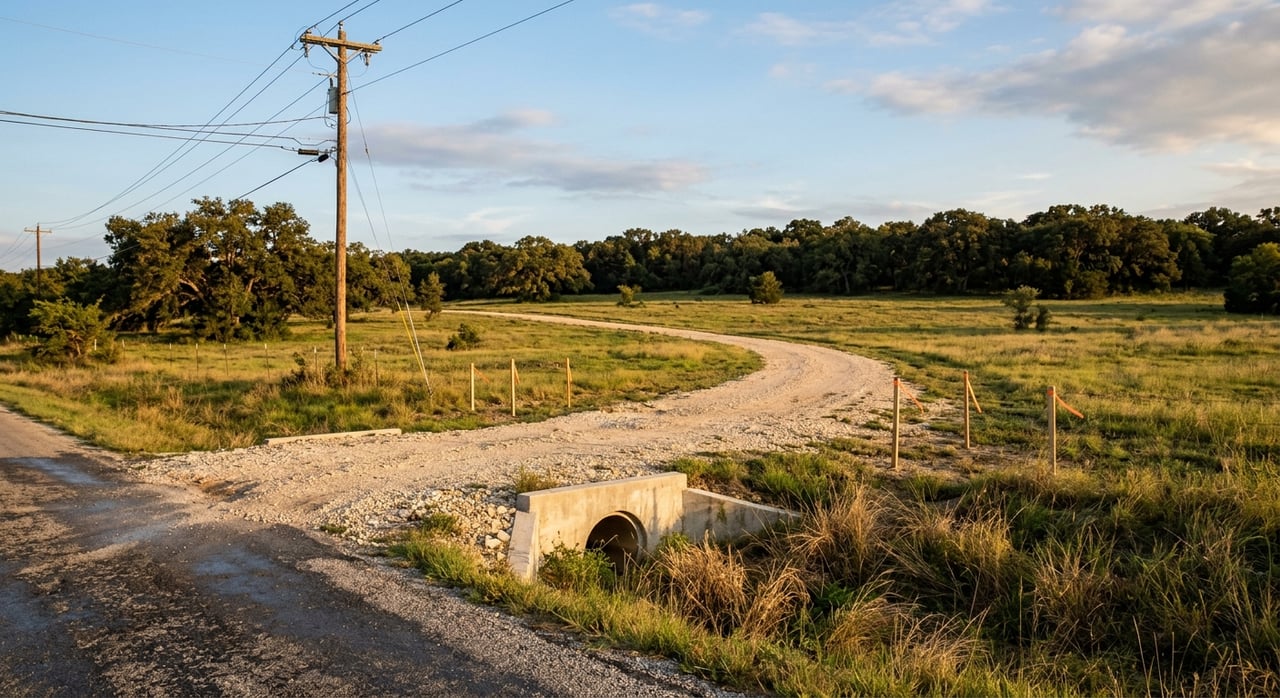
The county subdivision rules also require a finished driveway at least 22 feet wide. Depending on the site, culvert work may be required at the direction of the precinct commissioner, and a 9-1-1 address must be visible and readable from the public road.
If your land fronts a state highway, do not assume access is automatic. TxDOT requires an access-driveway permit for new or modified access driveways serving property that abuts the state highway system.
For a builder buyer, that can affect timing, design, and cost. If highway frontage is part of your tract’s value story, it is smart to identify that permitting step early.
Some rural tracts have never had a formal address or have confusing road or easement naming. In unincorporated areas and some cities, Parker County 911 Addressing handles address assignment, road and easement naming, and precinct verification.
That may sound minor, but it can help clean up confusion before a buyer starts planning lots, entrances, or utility service. A verified address and road record can make your listing package feel more complete and more credible.
Utilities can make or break a land deal. In Parker County, sellers do not need to solve every utility issue before listing, but you should be able to show what path appears available.
The county subdivision rules require plats to show utility easements and include either a letter of serviceability from water or sewer providers or a statement that no service is available within 300 feet and that private wells are suitable. That means buyers will want more than general assumptions.
Parker County regulates on-site sewage facilities in the unincorporated area. The county also notes that it does not guarantee adequate water at a proposed well site.
The Upper Trinity Groundwater Conservation District serves Parker County, and its new-well application asks whether public water is available and whether a local permit is required before drilling. The district also states that there is no guarantee that adequate water exists at the proposed well site.
If your tract does not have public water or sewer nearby, that does not automatically stop a sale. It simply means the private well and on-site sewage path should be documented early so buyers understand the likely route.
Floodplain and drainage are not side notes for builder-focused land. They directly affect lot layout, road planning, engineering costs, and the number of usable homesites.
Parker County subdivision rules require drainage structures and floodplain locations to be shown on the plat. The rules also require finish floors for structures to sit at least two feet above the applicable 100-year floodplain elevation.
In some areas near a waterway, a topographic plat may also be required. If your land includes creek frontage, low areas, or visible drainage paths, getting that information organized early can help a builder evaluate the tract with more confidence.
One of the biggest points of confusion for landowners is assuming the county approval process works like a city building-permit system. In unincorporated Parker County, there are no zoning requirements, and the county does not issue building permits or certificates of occupancy.
That does not mean there are no rules. For land division and development layout, platting is the main formal approval path.
The county’s platting page shows a Monday-noon submission deadline, and the fee schedule states that plats must be approved by the city or governing body and by Commissioners Court. If your tract is inside a city’s ETJ, city plat approval comes first.
Before a plat can be recorded, the county requires tax certificates showing delinquent ad valorem taxes are not owed, along with ownership and lienholder certification from an abstract or title company. The county also makes clear that the developer, not the county, is responsible for complying with environmental, water-supply, and other applicable laws.
For sellers, the takeaway is simple: your land becomes more attractive when you can show buyers where the likely approval path starts and what documents are already lined up.
Taxes can materially affect your net proceeds, especially if the land has agricultural appraisal and a future buyer is likely to change the use. In Parker County, property appraisals and assessments come from the Parker County Appraisal District.
Texas law allows qualified farm and ranch land to receive productivity-based special appraisal instead of market-value appraisal. But if land receiving agricultural appraisal changes to a non-agricultural use, rollback tax can apply for the previous three years. The Comptroller also notes that certain 1-d land can incur interest.
You can absolutely sell land that still has ag valuation. The important part is understanding whether a change in use could trigger additional tax exposure and how that may affect negotiations.
If a builder is likely to move the tract toward development soon after closing, it is wise to quantify that rollback exposure before setting a builder-facing price. If you are trying to preserve ag appraisal while marketing, use matters, not just ownership, so coordination with the appraisal district and a tax professional is important.
Acreage alone does not determine value in a builder sale. A tract with verified access, cleaner title, documented utility options, and known floodplain conditions may justify a meaningfully different price than a similar-sized tract with more unknowns.
Texas A&M’s Real Estate Research Center reported statewide rural land prices of $5,246 per acre in first-quarter 2026, up 6.02 percent year over year. But it also says those figures are only a guide to market trends and are not a substitute for a local appraisal or market study.
The same research notes that smaller tracts often command higher per-acre prices than neighboring larger tracts because they appeal to a broader buyer pool. In Parker County, that means tract size is only part of the pricing conversation.
When builders evaluate land, they often work backward from what finished lots may be worth. From there, they subtract expected costs and risks such as:
This is why preparation matters so much. The more uncertainty a buyer sees, the more padding they may build into their offer.
If you want to make your Parker County land more builder-ready before listing, focus on these steps:
Selling land to a builder is different from selling a typical homesite. You are not just marketing acreage. You are presenting a development opportunity with a risk profile.
That is where local coordination matters. Lori Mayo Real Estate Group can help you assemble a stronger due-diligence package, position the property for the right buyer audience, and coordinate with the surveyor, title company, engineer, attorney, and county contacts involved in the process.
Formal approvals still rest with the appropriate county, city, and state authorities. But when your listing is prepared with fewer unknowns and a clearer story, you are in a better position to attract serious interest and negotiate from strength.
If you are thinking about selling acreage or development land in Parker County, the team at Lori Mayo Real Estate Group can help you prepare the property, shape the pricing strategy, and bring it to market with local insight and high-visibility exposure.
Stay up to date on the latest real estate trends.