Buying Land Near Springtown: Well, Septic & Access Guide
Thinking about buying land near Springtown? The biggest surprises usually are not about price alone. They are about whether the property can support a well, pass septic review, provide legal access, and allow the use you have in mind. If you want to avoid expensive mistakes, it helps to know what to check before you make an offer. Let’s dive in.
When you buy rural land in or near Springtown, you may not be dealing with traditional zoning in the same way you would inside a city. Parker County states that there are no zoning requirements in unincorporated areas, and the county does not issue building permits or certificates of occupancy, though it does regulate development in special flood hazard areas and administers stormwater rules. That makes practical land questions even more important than a simple land-use label. You can review that framework on the Parker County septic and development information page.
In plain terms, that means you should focus on four basics early: water, septic, access, and restrictions. If one of those pieces does not work, the tract may not fit your plans, even if the land looks perfect on paper.
Parker County is served by the Upper Trinity Groundwater Conservation District, which adopted permanent rules in 2019. According to the district’s management plan, those rules keep registration requirements in place and add permitting requirements for non-exempt wells. The district also uses spacing rules to reduce interference with existing wells and adjoining landowners.
That matters because a buyer cannot assume a new well will be simple just because nearby properties have one. The district’s current new-well application asks about public water availability, possible rule exceptions, local permit requirements, minimum tract size, and spacing from property lines and other wells.
One of the most important details in the district’s application materials is the reminder that there is no guarantee adequate water exists at the proposed site. That is a key point for land buyers. A tract may appear to have well potential, but that does not mean it will provide reliable production.
If the property already has a well, you should ask for more than a casual statement from the seller that it works. You want to understand whether it is registered, whether it is exempt or non-exempt, and whether the paperwork is current.
The district’s transfer-of-ownership form explains that some wells may be exempt from metering, reporting, and fee requirements if they are used only for domestic, agricultural, or irrigation purposes, or if they fall below certain production thresholds. It also says a new owner must notify the district within 90 days after a change in ownership and may need registration paperwork if none already exists.
That makes document review part of your due diligence. If a tract has an existing well, you should confirm not only that the well exists, but also that the district records line up with the property you are buying.
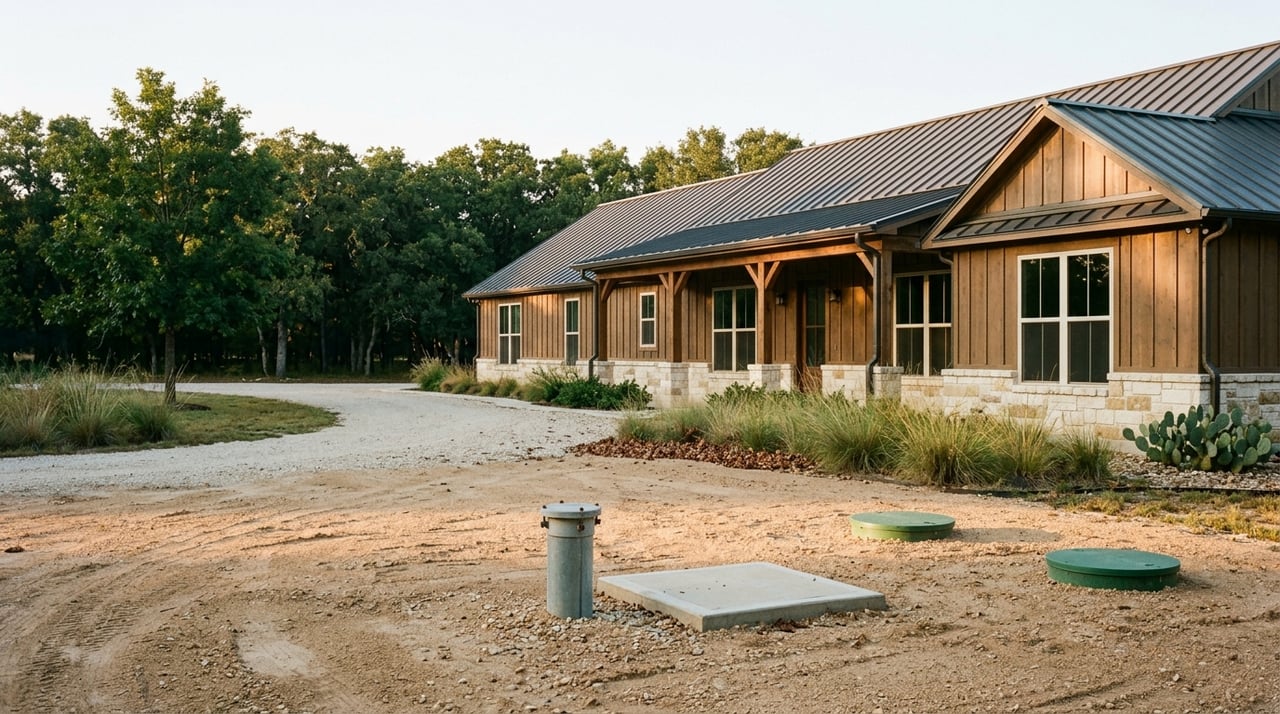
If public sewer is not available, the property will likely need an on-site sewage facility, often called an OSSF. According to the Texas Commission on Environmental Quality, a septic system needs a permit and approved plan before it can be constructed, installed, altered, extended, or repaired. The site must also be evaluated first by a licensed site evaluator or professional engineer.
This is why land buyers should not stop at, “There is plenty of room for septic.” Size alone is not the real question. The real question is whether the site and soil conditions support the kind of system your future home will need.
Parker County’s current OSSF permitting requirements require state-approved forms, a site and soil evaluation, and a plat or survey with the legal description and lot size. For aerobic systems, the county also requires a service contract and an affidavit to the public. The county permit sheet lists a $480 permit fee and states that no physical parts of the system may be installed until approval is confirmed.
For you as a buyer, that means a prior verbal opinion is not enough. If the tract has an existing septic system, ask for the permit and as-built if available. If it does not, ask for a current site and soil evaluation so you can better understand what type of system may be allowed.
Access can be one of the most overlooked issues in rural land sales. Parker County notes that Precinct 2 maintains more than 395 miles of roadway, but many roads are not county-maintained. Private subdivision roads, developer-maintained roads, roads inside cities, and U.S., state, or FM roads may fall under different maintenance responsibility.
That means one of your first questions should be simple: What kind of road serves this tract? A property on a private road can involve different upkeep expectations than one on a county-maintained road.
If your driveway or culvert uses county right-of-way, Parker County says a permit is required. The same county page states that no driveway or utility construction may begin without a permit and that culvert type and size must be approved first.
This can affect both cost and timing. If you are budgeting for a house, barn, or shop, it is smart to account for access improvements before closing, not after.
Parker County’s 911 Addressing office helps with address location and precinct verification. The county’s subdivision rules also require plats to show driveways and easements, and street names and numbers must be approved by the 911 coordinator.
That is another reason to review the survey and any available plat carefully. Easements, driveway locations, and address approval can all affect how the land functions in real life.
In unincorporated Parker County, buyers often assume fewer rules mean unlimited freedom. In reality, recorded deed restrictions may be the bigger issue. Parker County’s deed-restriction packet explains that deed restrictions are restrictive covenants found in a properly recorded deed, map, plat, replat, declaration, or similar instrument filed in county real-property records. It also states that real covenants can run with the land and bind successive purchasers.
So even if there is no zoning, the recorded documents may still limit what you can do. Restrictions may affect things like land use, structure placement, or other property conditions, depending on the recorded instrument.
The Parker County Clerk states on its public records page that the online database is not the official repository and may not reflect the complete or unaltered records. For buyers, that means the safest source is the actual recorded document or a certified copy.
If you are serious about a tract, ask for the title commitment, survey, recorded restrictions, and any plat notes before you get too far down the road. That document package can reveal issues that are easy to miss in a quick online search.
Before you make an offer on land near Springtown, it helps to work through a simple checklist:
These steps can help you compare land options more clearly and avoid buying a property that creates unexpected cost, delay, or redesign.
Buying rural land involves more moving parts than many first-time land buyers expect. A tract can look ideal from the road, but the details in district forms, county permit sheets, surveys, plats, and recorded restrictions are what tell the real story.
That is where local guidance can make a real difference. When you know how to spot the practical issues early, you can move forward with more confidence and fewer surprises.
If you are considering acreage or rural property near Springtown, the Lori Mayo Real Estate Group can help you evaluate land with a local, practical approach so you can make a more informed decision.
Stay up to date on the latest real estate trends.